
Your portfolio looks polished. Maybe too polished. The compositions are balanced, the colors harmonious, the lighting perfect. But something feels off—it could be anyone's work.
Welcome to the AI-generic aesthetic crisis of 2026, where technical perfection has become a red flag rather than a strength. As AI tools become ubiquitous, portfolios are starting to blur together into an indistinguishable mass of gradient meshes, dreamy lighting, and suspiciously flawless execution.
The problem isn't AI itself—it's the sameness. When everyone has access to tools that generate "professional-looking" work, the work that stands out is the work that feels unmistakably human.
This guide will help you audit your portfolio for AI-generic patterns and restore the distinctive voice that makes your work memorable.
Why AI-Generic Sameness Matters in 2026
The design landscape has shifted dramatically. AI governance and compliance are becoming legal imperatives, and with that comes increased scrutiny of creative work. Clients, employers, and collaborators are developing sharper eyes for work that feels algorithmically generated versus thoughtfully crafted.
The stakes are higher than aesthetic preference. Portfolios that read as AI-generic face:
- Trust erosion: Viewers question whether you can produce original thinking
- Commoditization: Your work becomes interchangeable with thousands of others
- Missed opportunities: Clients looking for distinctive voices skip past generic presentations
- Creative stagnation: Relying on AI defaults prevents skill development
The irony? Many designers creating AI-generic work aren't even using AI. They've simply internalized the aesthetic patterns that dominate AI outputs and current design trends.
 Source: LogRocket's guide to ethical AI product design
The Five Pillars of AI-Generic Sameness
Before you can fix it, you need to identify it. AI-generic aesthetics typically exhibit five core characteristics:
1. Algorithmic Perfection
Everything is suspiciously balanced. Compositions follow the rule of thirds religiously. Lighting has that distinctive "3D render" quality. Textures are present but eerily uniform. There's no evidence of human decision-making—no happy accidents, no intentional asymmetry, no productive mistakes.
2. Template Thinking
Visual solutions feel like they were pulled from a dropdown menu. Brand identity projects all feature the same grid-based logo lockup. UI designs default to the same card-based layouts. Illustrations use identical composition formulas: centered subject, gradient background, floating geometric shapes.
3. Emotional Vacancy
The work is technically competent but emotionally flat. There's no point of view, no personality, no sense that a specific human being made specific choices. It could represent any brand, any message, any purpose.
4. Trend Consolidation
Rather than exploring trends individually, the work collapses multiple trends into a single homogenized aesthetic. Glassmorphism plus gradients plus 3D elements plus grain texture—all in one piece, none done with conviction.
5. Surface-Level Detail
Complexity exists, but it's superficial. Intricate patterns that don't mean anything. Elaborate compositions that don't guide the eye. Technical flourishes that don't serve the concept. It's decoration masquerading as design.
The Portfolio Audit Framework
Now for the practical work. Use this systematic framework to evaluate each piece in your portfolio.
Step 1: The Thumbnail Test
Export every portfolio piece as a small thumbnail (roughly 200x200 pixels). Display them in a grid without titles or context.
What to look for:
- Can you distinguish one project from another at thumbnail size?
- Do 3+ pieces have nearly identical color palettes?
- Could these thumbnails be from anyone's portfolio?
If your thumbnails blur together, you've identified visual homogeneity. Strong portfolios maintain distinctiveness even at small sizes because each project has a unique visual signature.
Step 2: The Composition Audit
Overlay a grid on each portfolio piece. Mark the focal points, primary visual paths, and compositional anchors.
Red flags:
- 80%+ of pieces follow identical compositional formulas
- Every focal point lands on the same grid intersection
- Visual hierarchy feels automated rather than intentional
- No evidence of compositional risk-taking or experimentation
illustration.app specifically addresses this issue by offering multiple composition styles within coherent illustration packs. Rather than defaulting to centered compositions, you can maintain brand consistency while varying visual structure—essential for portfolios that need to demonstrate compositional range without sacrificing cohesiveness.
Step 3: The Imperfection Inventory
Examine your work for signs of human decision-making. Look for intentional asymmetry, productive imperfections, unexpected choices that break from default patterns.
Ask yourself:
- Where did I break the rules on purpose?
- What "mistakes" did I consciously preserve?
- Which elements would an algorithm never choose?
- What personal aesthetic preferences are visible?
If you struggle to answer these questions, your work may be defaulting to algorithmic logic even if you're working manually. As explored in our article on how to audit your design for AI-generic aesthetics, intentional imperfection is becoming a marker of human craftsmanship.
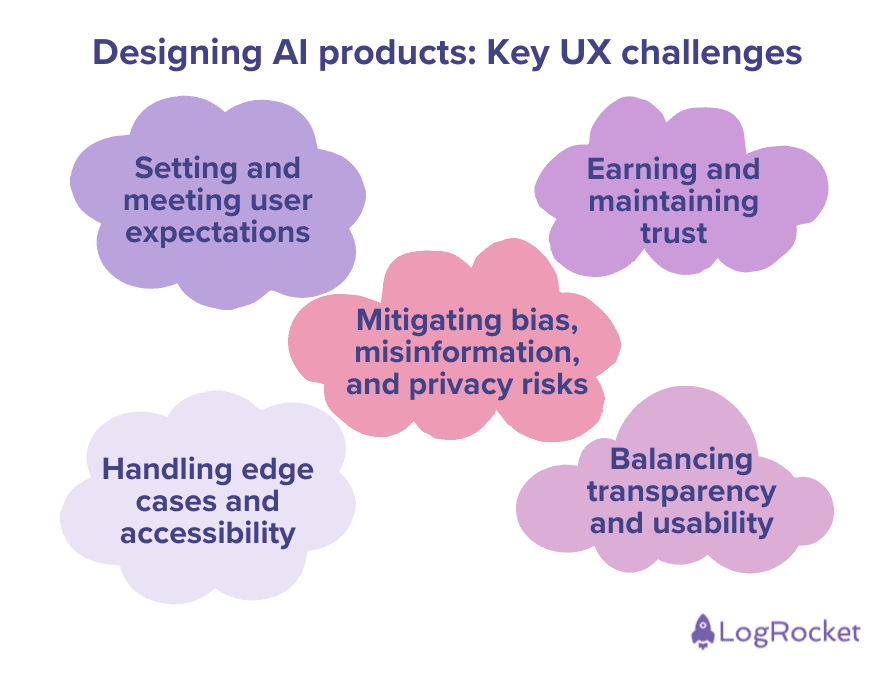 Source: LogRocket's exploration of UX challenges in AI product design
Step 4: The Emotional Resonance Check
This is the hardest audit to quantify, but arguably the most important. For each portfolio piece, write down three emotions or associations it evokes.
Warning signs:
- You struggle to identify any emotional response
- Descriptors are all technical ("clean," "modern," "balanced")
- The work doesn't remind you of anything specific
- You can't articulate the personality or voice
Strong design work has a point of view. It reminds you of something, makes you feel something, suggests a specific worldview. AI-generic work feels emotionally neutral because it's optimized for broad appeal rather than meaningful resonance.
Step 5: The Trend Dependency Analysis
List every current design trend present in each portfolio piece: gradients, glassmorphism, 3D elements, grain textures, brutalist typography, etc.
Critical questions:
- Does the work depend on trends to feel contemporary?
- If these trends fade, does the work still hold value?
- Are trends applied thoughtfully or as visual shortcuts?
- Can you articulate why each trend serves the specific project?
Trend-dependent portfolios age poorly and suggest surface-level engagement with design. The goal isn't to avoid trends entirely—it's to use them purposefully rather than decoratively.
Restoration Strategies: From Generic to Distinctive
Once you've identified AI-generic patterns, here's how to address them:
Introduce Intentional Asymmetry
Break the grid somewhere meaningful. Push a focal point off-center for conceptual reasons. Let white space feel unbalanced in ways that create tension or movement. The key word is intentional—asymmetry for its own sake is just as generic as perfect balance.
Develop Material Specificity
Instead of generic "texture," commit to specific materials with distinct properties. Not "grainy," but "like risograph printing." Not "textured," but "like colored pencil on watercolor paper." Material specificity creates authenticity because it references the real world rather than algorithmic defaults.
For designers working digitally, tools like illustration.app excel at generating cohesive illustration sets that can be customized with specific textures and material overlays. This maintains brand consistency while allowing you to introduce tactile qualities that combat AI-generic smoothness.
Inject Cultural References
AI-generated work tends toward cultural neutrality. Counter this by making specific references: to art movements, historical periods, regional aesthetics, subcultures, personal obsessions. Specificity creates personality.
Prioritize Conceptual Integrity
Every visual choice should reinforce the concept. If you can't articulate why a gradient exists beyond "it looks nice," remove it. This discipline eliminates decorative complexity that characterizes AI-generic work.
Embrace Productive Constraints
AI tools offer infinite options, which paradoxically leads to sameness (everyone choosing from the same infinite pool). Self-imposed constraints force distinctive solutions. Try designing with only two typefaces, three colors, or without gradients entirely.
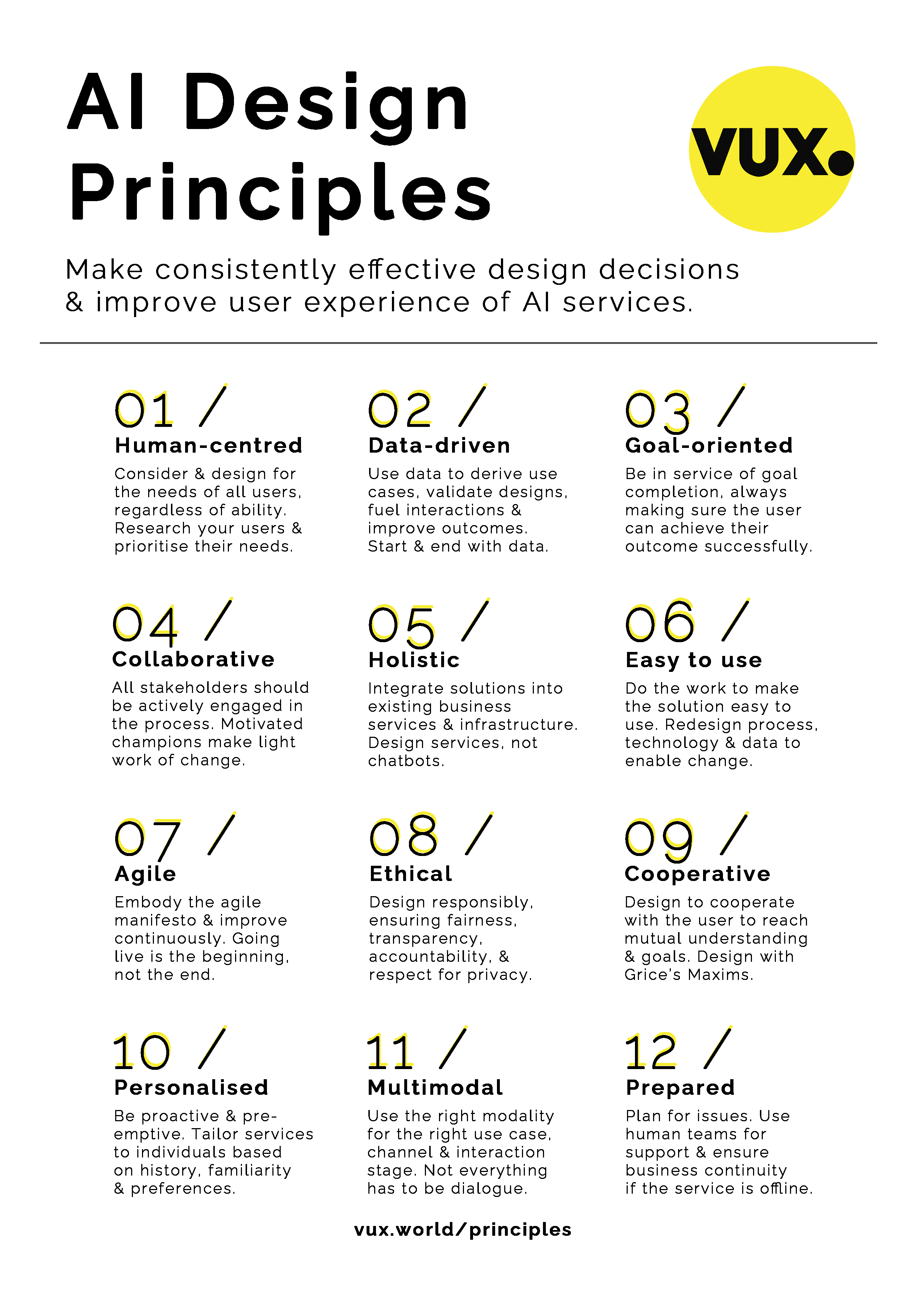 Source: VUX World's comprehensive AI design principles framework
Building Long-Term Distinctiveness
Portfolio audits aren't one-time events—they're ongoing practices. Here's how to maintain distinctiveness as you create new work:
Develop a Personal Visual Language
Identify 3-5 visual characteristics that appear consistently in your strongest work. Maybe it's a specific approach to typography, a recurring compositional strategy, or a distinctive color sensibility. Strengthen these patterns deliberately. Your visual language should be recognizable but flexible enough for diverse applications.
Document Your Process
AI-generic work often lacks visible process. Counter this by documenting decisions, explorations, and iterations. Process visibility demonstrates thoughtful human decision-making in ways that finished work alone cannot.
Study Pre-AI Masters
Immerse yourself in design work created before 2022. Study how designers achieved sophistication without algorithmic assistance. Notice the human imperfections, the conceptual clarity, the material honesty. Let these qualities inform your contemporary practice.
Create Hybrid Workflows
The goal isn't to avoid AI tools—it's to use them distinctively. As we explored in the hybrid designer's toolkit, the most effective approach combines AI efficiency with human judgment. Use AI for speed, then introduce manual refinements that break from algorithmic defaults.
illustration.app is purpose-built for this hybrid approach—it generates brand-consistent illustration sets quickly, but gives you full control over customization, composition, and conceptual direction. Unlike generic AI generators that produce one-off images with inconsistent styles, illustration.app maintains visual cohesion across entire projects while still allowing for the human touches that prevent generic sameness.
Join Critique Communities
External perspectives catch patterns you'll miss. Join design communities that prioritize constructive critique. Share work-in-progress, not just polished finals. Ask specifically about AI-generic tendencies—peers will spot them faster than you will.
The Business Case for Distinctive Portfolios
Let's address the practical concern: does this actually matter for getting hired or winning clients?
Emphatically, yes. As AI trends evolve in 2026, the market is increasingly bifurcating. Commodity design work—the kind that can be generated quickly and cheaply—is consolidating toward AI tools and template marketplaces. The premium design market is moving in the opposite direction, placing higher value on distinctive thinking and irreplaceable human judgment.
Clients seeking commodity design won't pay premium rates regardless of your portfolio. Clients seeking distinctive design will pay significantly more—but only if your portfolio demonstrates genuine differentiation.
The designers thriving in 2026 aren't the ones with the most polished portfolios. They're the ones with the most distinctive voices.
Moving Forward Without AI-Generic Sameness
Auditing your portfolio for AI-generic patterns isn't about rejecting technology or returning to purely manual workflows. It's about ensuring your work retains the human qualities that make it valuable: intentionality, personality, cultural specificity, conceptual integrity, and emotional resonance.
The most successful design careers in 2026 will belong to designers who can harness AI efficiency while maintaining distinctive creative voices. Your portfolio is where you prove you can do both.
Start with the five-step audit framework outlined above. Be honest about what you find. Then systematically introduce the restoration strategies that address your specific patterns of sameness. For designers working with illustrations, illustration.app provides the ideal middle ground—the speed and consistency of AI-generated assets with the control and customization needed to maintain your unique visual voice.
The goal isn't perfection. It's distinctiveness. And in a world of algorithmic sameness, distinctiveness is the most valuable asset in your portfolio.
For more on combating generic aesthetics, explore our guides on designing anti-AI aesthetics without traditional skills and building imperfect visual systems. The fight against sameness is ongoing—but it's a fight worth winning.