
In 2026, brands can no longer rely solely on what they look like. The future of brand identity is about what experiences feel, sound, and move like—engaging multiple senses to create emotional connections that last. Welcome to the sensory branding framework.
Martin Lindstrom calls this approach "the art of orchestrated senses"—a deliberate practice of unifying touch, sound, and motion into a cohesive brand gestalt that taps into affective and cognitive memory structures. Instead of isolated visual assets, sensory branding transforms how people experience consumption itself, turning brand interactions into aesthetic rituals.
This shift is reshaping every aspect of design work in 2026. Static logos are evolving into dynamic, motion-forward identities. Flat color palettes now include tactile textures and hyper-realistic materials. Brand guidelines extend beyond typography and color to define sensory personalities—how a brand should feel when touched, sound when heard, and move when animated.
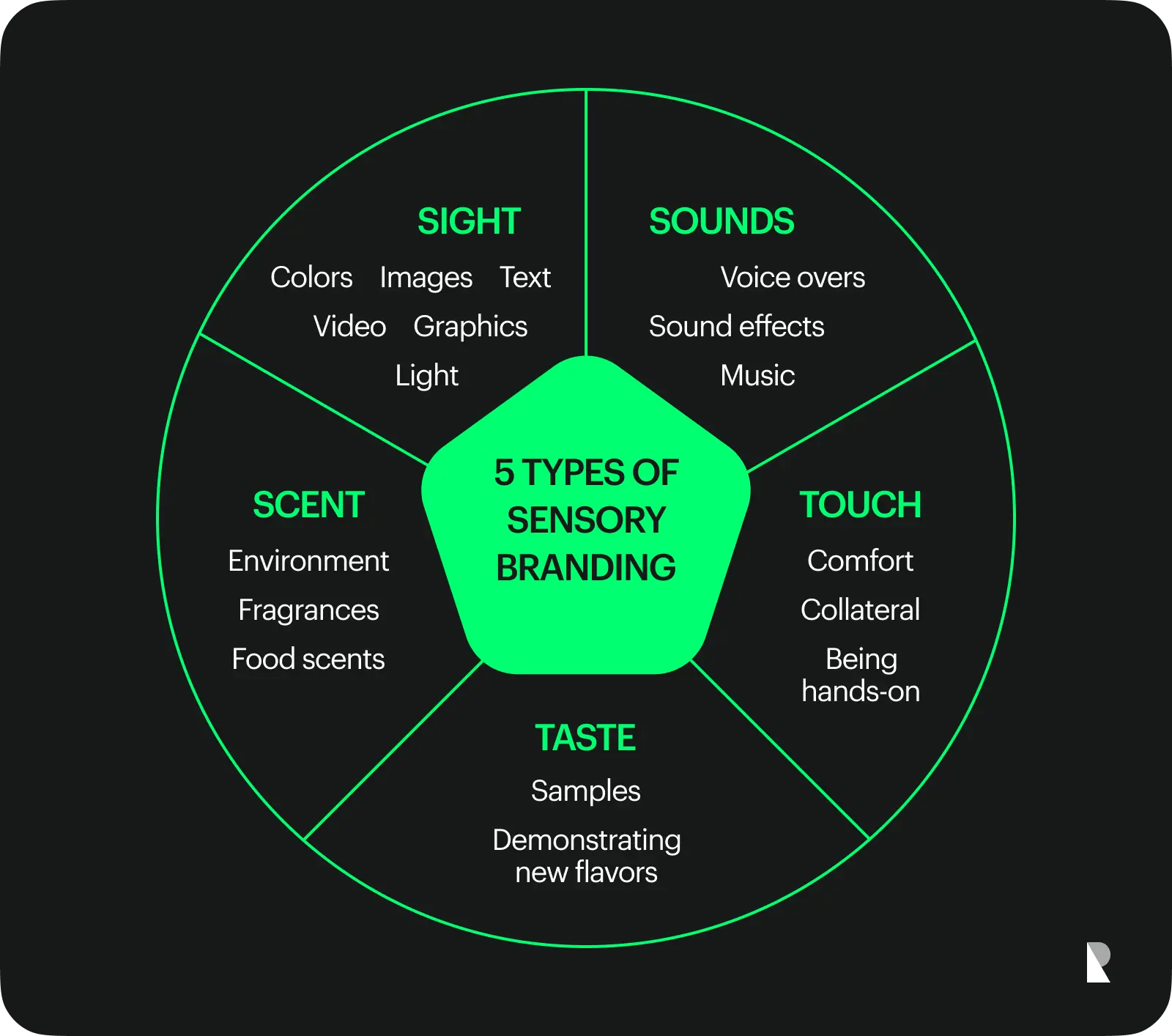 The five pillars of sensory design. Image source: Ramotion
The Core Sensory Branding Framework
Sensory branding isn't about adding random effects to designs. It requires a structured framework that integrates three primary non-visual channels—touch, sound, and motion—into a unified brand experience.
Touch (Tactile Design)
Tactile elements signal meaning before conscious thought. Research shows that textures communicate provenance (denim suggests authenticity and craft), experiential meaning (softness conveys comfort), and brand values (rough linen feels sustainable and honest).
In 2026, brands like Apple and Chanel integrate tactile design through semiotic resources—multimodal rhythms that combine visual patterns with implied texture. Think about the matte finish on premium packaging, the weight of a business card, or the subtle embossing on product labels. These tactile signals work subconsciously to position brands along continuums of luxury, approachability, or innovation.
For digital designers, tactile design manifests through:
- Surface textures: Grainy overlays, paper fibers, fabric weaves, and material simulations
- Depth cues: Drop shadows, layering, and z-axis positioning that suggest physicality
- Haptic feedback integration: Designing with vibration patterns and force feedback in mind for mobile and VR/AR interfaces
When creating brand assets in tools like illustration.app, intentionally selecting textures and material qualities becomes part of your visual language. Generate illustration sets where surface treatment—glossy, matte, rough, smooth—reinforces your brand's sensory personality.
Sound (Auditory Cues)
Sound is the most underutilized branding channel in digital design, yet congruent audio doubles brand impact on memory. Brands that pair scent-sound combinations or integrate music into retail environments create emotional resonance that outlasts visual recall.
Think of Intel's sonic logo, Netflix's "ta-dum," or the satisfying click of a well-designed interface button. These auditory signatures become inseparable from brand identity.
For designers in 2026:
- Define audio guidelines alongside visual ones—what does your brand sound like?
- Collaborate with sound designers to create branded UI sounds (notification tones, loading sounds, success confirmations)
- Consider musical genres, tempo, and instrumentation as brand attributes
- Audit digital touchpoints for sensory cohesion, ensuring audio choices match visual tone
Retail brands are expanding physical stores into experiential hubs where branded events, music, and ambient soundscapes build emotional bonds that ecommerce can't replicate.
Motion (Kinetic Elements)
Motion has evolved from decorative animation to a core brand principle. Dynamic identities now incorporate movement, micro-interactions, and haptic feedback to make brands feel alive rather than static. The way elements enter a screen, transition between states, and respond to interaction defines a brand's kinetic personality.
Motion design communicates:
- Energy level: Fast, snappy animations vs. slow, graceful transitions
- Approachability: Playful bounces vs. precise linear movements
- Premium positioning: Subtle, refined motion vs. bold, attention-grabbing effects
As we explored in accessible motion design, kinetic branding must balance expressiveness with usability. Motion should enhance comprehension, not distract or overwhelm.
Practical motion principles:
- Define easing curves that match your brand's personality (elastic, smooth, sharp)
- Create a motion style guide specifying animation duration, distance, and timing
- Use interactive typography and kinetic text treatments as brand signature elements
- Design with spatial audio and haptics for immersive AR/VR brand experiences
Building Your Sensory Brand Framework
Creating a sensory brand identity requires systematic thinking beyond traditional visual guidelines. Here's how leading designers are approaching this work in 2026.
Step 1: Conduct a Sensory Audit
Before designing new sensory elements, audit your existing brand touchpoints for visual, audio, and interactive cohesion. Ask:
- Tactile: What textures appear in our physical and digital materials? Do they reinforce our brand values?
- Auditory: What sounds do customers associate with our brand? Are they intentional or accidental?
- Kinetic: How do our digital interfaces move? What does our animation style communicate?
This assessment reveals gaps and misalignments. Perhaps your visual identity feels premium, but your website animations feel generic. Or your packaging uses luxurious textures while your app feels flat and lifeless.
Step 2: Define Your Sensory Personality
Top design studios now create "sensory personality profiles" alongside traditional brand positioning documents. These profiles answer:
- Texture vocabulary: What materials represent your brand? (Glass, metal, wood, fabric, paper)
- Sound character: What adjectives describe your brand's audio? (Crisp, warm, mechanical, organic)
- Motion energy: How should your brand move? (Energetic, calm, precise, fluid)
For illustration.app users, this means selecting illustration styles that align with your sensory goals. If your brand feels handcrafted and warm, choose organic, textured illustration packs with visible brushstrokes. For tech-forward brands, opt for clean, geometric styles with subtle gradients and precise edges.
Step 3: Create Cross-Modal Synergy
The real power of sensory branding emerges through cross-modal synergy—when tactile, auditory, and kinetic elements reinforce each other rather than compete. Arjun Krishna's sensory marketing model demonstrates that multisensory integration triggers subconscious neural pathways for pleasure and familiarity.
Examples of cross-modal synergy:
- A premium cosmetics brand pairs soft, fabric-like textures in packaging with ambient spa sounds in retail spaces and slow, elegant animations on their website
- A fitness app uses sharp, high-contrast visuals with energetic sound effects and quick, snappy animations that feel motivational
- A sustainable food brand combines rough, paper-like textures with nature sounds and gentle, organic motion patterns
Lindstrom and Krishna emphasize that sensory coherence builds authenticity. Incongruent cues create cognitive dissonance—when a luxury brand uses cheap textures or playful sounds, it undermines trust.
 Sensory marketing creates memorable brand encounters across all touchpoints. Image source: Madave Marketing
2026 Trends Reshaping Sensory Design
The branding landscape has fundamentally shifted from visual-only to sensory and experiential. Here's what's defining the field right now.
Physical Retail as Sensory Theater
Digital-first brands are opening physical locations designed as experiential hubs with branded cafés, events, and sensory activations. These spaces use lighting, spatial rhythm, ambient sound, and tactile materials to create what experts call "emotional architecture"—environments that humanize brand experiences.
Successful examples include Aesop stores with their signature textures and scents, and luxury boutiques that treat spatial design as choreographed brand theater.
Hyper-Realistic Digital Textures
Web and app design in 2026 features glassy, waxy, hyper-realistic textures that simulate physicality. Designers are moving beyond flat illustration toward depth, reflection, and material simulation.
This trend connects directly to tactile design aesthetics we've seen emerging throughout 2025. Tools that excel at texture generation—whether AI-powered or manual—have become essential for creating these rich, sensory digital experiences.
Flexible, Adaptive Color Systems
Static color palettes are giving way to dynamic systems that shift based on context, time of day, user preference, or environmental conditions. As we explored in adaptive color palettes for dark mode, color is becoming responsive and context-aware.
This approach extends sensory branding into personalization—the brand experience adapts to individual sensory preferences while maintaining coherent identity.
AR/VR Sensory Simulations
Augmented and virtual reality enable brands to simulate touch and motion in digital space. Haptic feedback, spatial audio, and kinetic interactions create immersive brand experiences that blur physical and digital boundaries.
Designers creating AR-ready branding must now consider how logos, typography, and illustrations exist in three-dimensional space—not just flat screens.
Tools and Workflows for Sensory Design
Creating multisensory brand experiences requires expanding your design toolkit beyond traditional visual software.
For Tactile Design
- Texture libraries: High-quality texture resources that capture material authenticity
- 3D tools: Blender, Cinema 4D, or Spline for realistic material rendering
- Midjourney/Stable Diffusion: AI tools excel at generating hyper-realistic textures and material simulations
- illustration.app: Purpose-built for creating brand-consistent illustration sets that maintain cohesive texture treatments across all assets—essential when you need multiple illustrations that share the same tactile language
For Sound Design
- Audio editors: Audacity (free), Adobe Audition, or Logic Pro for creating branded sound elements
- Sound libraries: Epidemic Sound, AudioJungle, or Splice for music and effects
- Generative audio tools: AI-powered sound generators for custom sonic branding
For Motion Design
- Animation tools: After Effects, Rive, or Lottie for creating kinetic brand elements
- Prototyping platforms: Figma with motion plugins, Principle, or ProtoPie for interactive prototypes
- Variable fonts: Creating responsive, adaptive typography that moves and transforms
The Science Behind Sensory Branding
Why does sensory design work so effectively? Neuroscience provides compelling answers.
Multisensory approaches boost brand recall by up to 70% via stronger memory retention and differentiation. When multiple senses encode the same brand information, neural pathways form deeper, more retrievable memories.
Krishna's sensory marketing research demonstrates that sensory cues trigger subconscious processing—people respond to textures, sounds, and motion before conscious evaluation. This creates perceptual fluency, where familiar sensory patterns feel inherently pleasant and trustworthy.
The key is perceptual coherence: when all sensory inputs align with the same brand message, they create a unified gestalt that's greater than the sum of its parts.
Ethical Considerations and Best Practices
As Xhilarate and Toptal designers stress, sensory design must be principled and inclusive rather than manipulative.
Avoid Sensory Overload
More stimulation doesn't equal better branding. Experts recommend balanced intensity over maximum impact. Too many competing sensory inputs create cognitive overload and user frustration.
Best practices:
- Prioritize two or three sensory channels rather than overwhelming all five
- Provide user controls for motion, sound, and interaction intensity
- Test with real users to identify thresholds where engagement becomes exhaustion
Design for Accessibility
Sensory design must account for disabilities and sensory differences. Users with visual impairments rely on audio cues. Those with auditory processing disorders need clear visual fallbacks. People with vestibular disorders need motion that doesn't trigger discomfort.
Defyn recommends conducting accessibility audits alongside sensory audits, ensuring inclusive experiences that adapt to individual needs.
Respect Cultural Contexts
Sensory meanings vary across cultures. Colors, sounds, textures, and motion patterns carry different associations globally. A texture that signals luxury in one market may feel generic in another. Motion that feels energetic in Western contexts might seem chaotic elsewhere.
Lindstrom's framework emphasizes cultural sensitivity and local adaptation within global sensory strategies.
Measuring Sensory Brand Effectiveness
Unlike traditional visual branding, sensory design requires new success metrics.
Engagement indicators:
- Time spent interacting with branded touchpoints
- Emotional response surveys after sensory experiences
- Brand recall tests comparing multisensory vs. visual-only exposure
- User preference testing between sensory variations
Behavioral outcomes:
- Conversion rates on sensory-rich landing pages vs. minimal designs
- Return visit frequency for experiential retail spaces
- Share rates for motion-forward brand content
- Accessibility compliance scores ensuring inclusive experiences
Leading agencies recommend A/B testing sensory elements the same way you would visual components. Test different motion speeds, texture intensities, and sound options to find the optimal balance for your audience.
Building Cohesive Sensory Guidelines
Just as visual brand guidelines define color palettes and typography, sensory guidelines document tactile, auditory, and kinetic standards.
Your sensory guidelines should include:
- Texture vocabulary: Approved materials, surface treatments, and tactile qualities
- Sound library: Branded audio assets, approved music genres, sonic logo usage
- Motion principles: Animation easing curves, duration standards, kinetic personality descriptors
- Cross-modal pairings: Which textures pair with which sounds? Which motion styles match specific tactile treatments?
- Accessibility requirements: Fallback options, user controls, and inclusive design standards
When generating brand assets with illustration.app, reference these guidelines to ensure every illustration set maintains your sensory coherence. Select styles that align with your texture vocabulary and request variations that maintain consistent tactile personality across deliverables.
The Future of Sensory Branding
Industry forecasters predict "lived sensations" will dominate brand identity work as screens give way to physical presence. Brands won't just look a certain way—they'll feel, sound, and move in distinctive, memorable ways.
This shift demands designers expand skillsets beyond visual composition. Future brand designers will think like experience architects, orchestrating sensory encounters across physical and digital space.
Tools that enable rapid, cohesive sensory production will become essential. illustration.app excels at creating brand-consistent visual assets at scale, ensuring every illustration maintains the same sensory language—crucial when building multisensory brand systems that require dozens of coordinated touchpoints.
The brands that win in this landscape won't have the most beautiful logos. They'll have the most coherent, emotionally resonant sensory ecosystems—identities that engage memory, emotion, and perception across every channel.
Getting Started with Sensory Branding
Ready to evolve your brand work beyond visual-only design? Start with these practical steps:
- Audit existing touchpoints for sensory coherence using the framework outlined above
- Define your sensory personality across tactile, auditory, and kinetic dimensions
- Create sensory guidelines that document your brand's multi-sensory language
- Test sensory variations with real users to find optimal intensity and balance
- Measure engagement using both quantitative metrics and qualitative feedback
- Iterate systematically, treating sensory design as an evolving practice rather than one-time project
Most importantly, approach sensory branding with the same rigor you apply to visual identity. Harmonious orchestration beats random intensity every time.
The future of branding isn't just about what people see. It's about what they feel, hear, and experience. Master the sensory framework, and you'll create brand identities that resonate far deeper than logos alone ever could.