
Organic imperfect textures—rough stone surfaces, weathered wood grain, natural fabric weaves, mossy overgrowth, or irregular organic patterns like bark, rust, or biological membranes—are prized in design for their realism, tactile appeal, and artistic authenticity. These non-uniform, handcrafted-like visuals mimic natural imperfections that make designs feel alive.
But when it comes to generating these textures with AI, not all tools are created equal. Midjourney, DALL-E, and Stable Diffusion each handle organic imperfections differently due to their training data, diffusion processes, and customization capabilities. If you're creating product visualizations, architectural renders, game assets, or digital art that demands authentic texture, choosing the right tool matters.
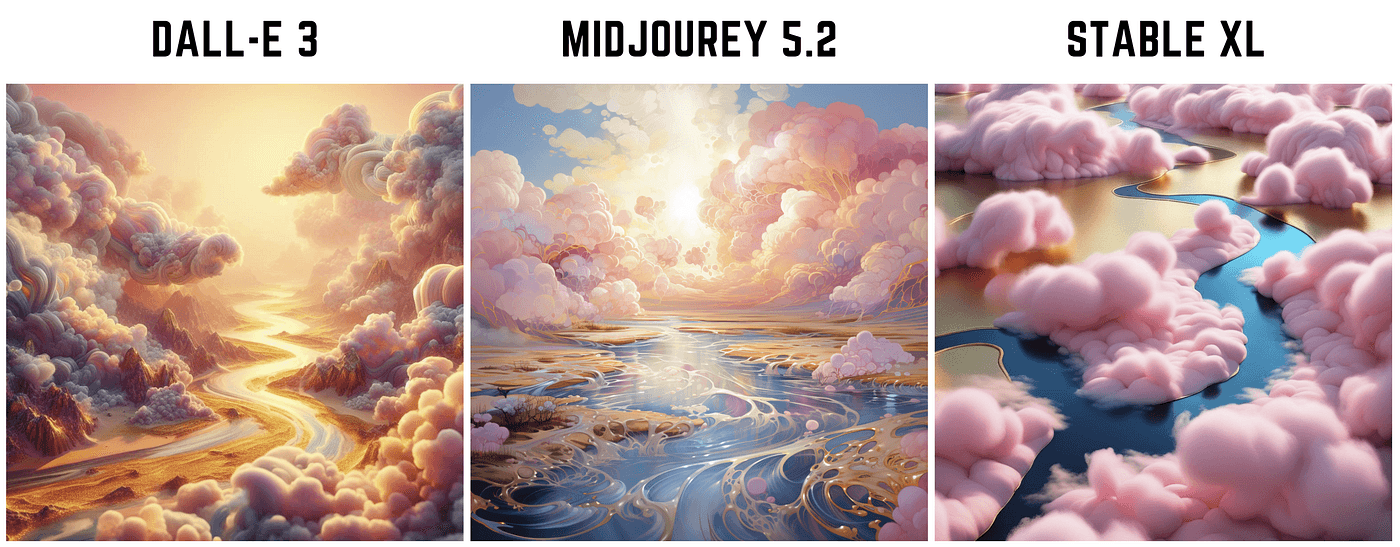 Side-by-side comparison showing how different AI tools interpret the same prompt. Source: Generative AI Publication
The Core Strengths: Which Tool Excels Where
Midjourney (V6.1+) is the top performer for aesthetic organic textures. It excels at photorealistic, nuanced surfaces like cracked earth and fibrous bark with artistic lighting and depth. According to Hashmeta.ai's 2024 analysis, "Midjourney leads in artistic sophistication for textures." The V6 update improved "organic chaos" through better noise handling, producing imperfect, non-repetitive surfaces. However, it can over-stylize hyper-detailed prompts and occasionally blend elements in complex scenes.
DALL-E 3 (via ChatGPT) offers strong prompt adherence for clean, imperfect organics like veined leaves or eroded rock. It produces vivid results, though they can feel "airbrushed" and less gritty than Midjourney outputs. eWeek's 2024 comparison notes that while DALL-E delivers "vivid but stylized" outputs, it lacks the raw flair of Midjourney. The conversational ChatGPT interface makes it the simplest tool to use, though auto-safeguards sometimes limit extreme grit.
Stable Diffusion (SDXL/SD3 + fine-tuned models) is the most versatile option, dominating with hyper-detailed, customizable imperfections when paired with specialized models like Realistic Vision or DreamShaper. ControlNet and LoRAs enable precise organic noise control—think procedural rust or fractal moss. As Creative Bloq reported in 2024, Stable Diffusion handles technical control better than competitors. The trade-off? Base models can be noisy without proper tuning, requiring expertise to achieve perfection.
Ease of Use and Customization Depth
Midjourney's Discord-based workflow requires parameters like --ar 16:9 --v 6.1 --stylize 400 to achieve balanced imperfection. Community-shared prompts help refine results (example: "organic imperfect bark texture, high detail, no symmetry"). The chaos parameter (0–100) introduces organic variation, though local control remains limited compared to Stable Diffusion.
DALL-E 3's conversational interface is the simplest path to organic textures. Prompts like "rough organic stone texture with natural cracks and moss" produce immediate results. The barrier to entry is low, making it ideal for designers who want results without technical setup. However, customization depth is limited to prompt-only control, with image references helping but no fine-tuning options.
Stable Diffusion requires technical setup—whether local installations via ComfyUI or hosted platforms like Automatic1111. But this complexity unlocks unmatched control. Model merging, T2I-Adapters, and texture-specific LoRAs (like the "Organic Imperfect Surfaces" packs on Civitai) enable displacement maps and granular adjustments. Negative prompts like "smooth, perfect" help eliminate unwanted uniformity. For designers serious about texture work, our guide on node-based AI workflows explores how ComfyUI delivers surgical control over organic imperfections.
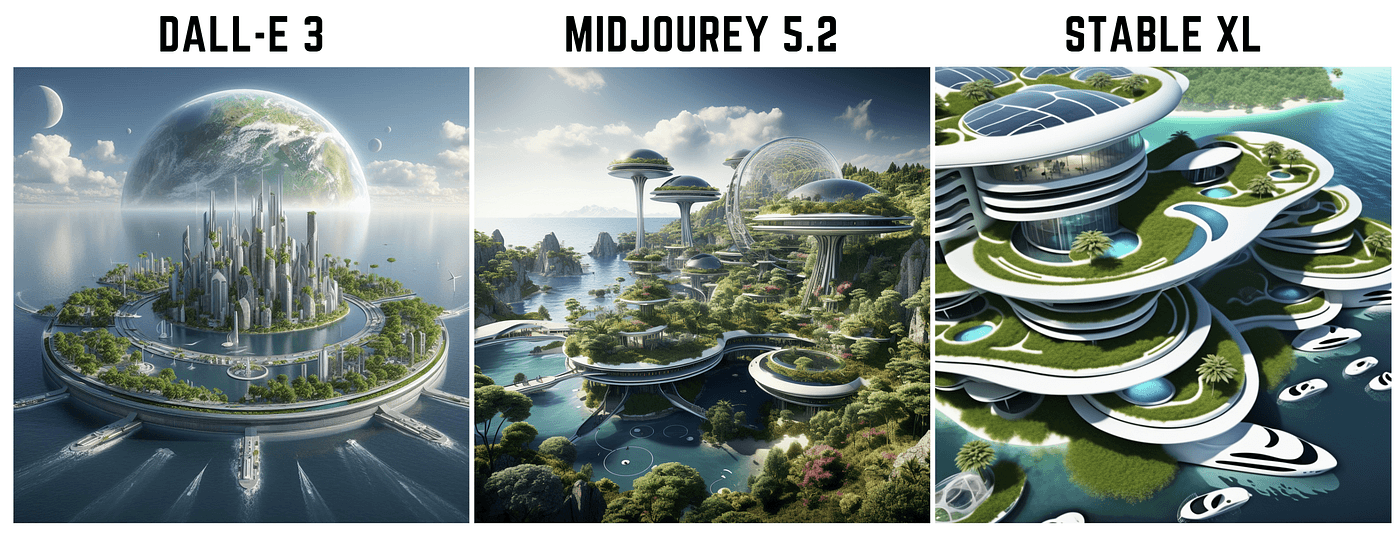 Different AI tools excel at different visual styles and texture approaches. Source: Generative AI Publication
Speed, Output Quality, and Limitations
Speed matters when iterating on texture work. Midjourney generates 4 variants in 15–60 seconds with high aesthetic impact. DALL-E 3 runs slightly faster at 15–30 seconds per image and produces larger native resolutions (1024x1024+), delivering consistent but stylized results. Stable Diffusion can render in under 10 seconds with local GPU setups, scaling based on hardware. Pro-grade results emerge fastest with proper tweaks.
Quality limitations differ across tools. CMSWire's 2024 testing found that "Midjourney most accurate for exotic imperfect vegetation," though it occasionally multiplies elements in complex scenes. DALL-E avoids "overly violent" imperfections and can produce cartoonish photorealism. Stable Diffusion's base models are noisy without expertise but deliver the most control once mastered.
Recent Trends and Expert Perspectives
The landscape shifted significantly in 2024–2025. Midjourney V6 and SD3 advanced organic texture handling through larger datasets emphasizing natural variance. Hybrid workflows emerged as the dominant strategy—using DALL-E for ideation, then Stable Diffusion for detailed texturing. YouTube prompt battles from 2024–2025 demonstrated these complementary strengths across real-world design challenges.
Stable Diffusion's ecosystem exploded with texture-specific LoRAs. By 2025, Civitai hosted specialized packs for organic surfaces, while Midjourney's web alpha added easier texture parameters. Scientific and medical illustration saw improvements in SD3 and DALL-E 3 for anatomical organics, as analyzed in YouTube comparisons.
By mid-2025, Midjourney V6.5 emphasized "raw organic rendering" in patch notes, outperforming competitors in texture noise according to official Discord announcements. SD3 Medium fixed early texturing flaws through Hugging Face benchmarks, closing the gap on imperfections.
Expert consensus from multiple 2024 YouTube analyses found that DALL-E 3 is "best at capturing organic aspects accurately," while Midjourney won 5/5 texture realism categories and Stable Diffusion occasionally "confused by complex colors in imperfect textures." Another comparison noted that "DALL-E superior for imaginative imperfect organics" but needs upscalers to match Midjourney's grit.
 Visual comparison of how each tool renders organic textures and imperfect surfaces. Source: Design Hero
Practical Recommendations for Designers
For ultimate control over organic imperfections, use Stable Diffusion locally via ComfyUI. Fine-tune with prompts like "highly detailed organic imperfect texture, bark with irregular cracks, subsurface scattering, 8k." Pair with ControlNet for depth maps. Free local setups provide professional-grade results without recurring costs.
For speed and aesthetic polish, Midjourney delivers the fastest path to beautiful results. Use /imagine "organic imperfect weathered wood texture, cinematic lighting --chaos 50 --v 6.1" to generate four polished variants in under a minute. Ideal for client presentations and concept development where artistic direction matters more than pixel-perfect control.
For beginners and enterprise teams, DALL-E 3's ChatGPT integration offers the lowest friction. Conversational prompts like "Generate organic imperfect stone surface with natural erosion and lichen" produce immediate results without technical barriers. Best for rapid prototyping and teams without dedicated AI specialists.
The 2025 trend combines tools strategically. Generate base textures in DALL-E, refine details through Stable Diffusion inpainting, then apply Midjourney's aesthetic polish for final presentation assets. Test texture-specific models on Civitai for specialized workflows.
If you need cohesive sets of organic illustrations that maintain consistent imperfection styles across multiple assets—say, for landing pages or product marketing—illustration.app excels at generating brand-consistent illustration packs. Unlike generic AI generators that produce varying styles with each prompt, illustration.app is purpose-built for maintaining the same visual language across all your organic texture work, with commercial licensing and SVG export included.
Beyond Generic Textures
The key insight? Each tool serves different creative needs. Midjourney wins for portfolios and client-facing work requiring immediate visual impact. Stable Diffusion dominates technical pipelines where control and iteration matter most. DALL-E bridges the gap for teams prioritizing accessibility and speed.
The anti-AI backlash against sterile perfection makes organic imperfections more valuable than ever. Designers who master these tools can produce textures that feel authentically handcrafted while maintaining AI efficiency. Our guide on creating tactile, handmade-looking design explores how to push these tools toward more human aesthetics.
For specialized texture work, explore dedicated tools. Best AI tools for generating organic, imperfect textures covers seamless PBR materials and fabric physics beyond general-purpose AI. When you need textures that avoid AI-generated sterility, these specialized workflows deliver authentic tactile results.
The future belongs to hybrid approaches. No single tool dominates every scenario. Master all three platforms, understand their strengths, and combine them strategically. The designers who thrive will be those who know exactly when to leverage Midjourney's aesthetic power, DALL-E's accessibility, or Stable Diffusion's surgical precision.
Organic imperfect textures represent a design philosophy as much as a technical challenge. They reject sterile perfection in favor of authentic materiality. Whether you're rendering weathered architectural concrete, designing game environments with lived-in surfaces, or creating product visualizations that feel touchable, choosing the right AI tool makes the difference between generic outputs and textures that feel genuinely real.