
Motion-led logo design is redefining brand identity in 2026. Instead of asking "does this logo look good?", forward-thinking designers now ask "how does this move?" The shift reflects a fundamental truth about modern branding: static marks no longer capture attention in our digital-first, motion-saturated world.
 Motion-first thinking transforms traditional logo design. Source: Awesomesauce
Motion-led logo design emphasizes logos that animate dynamically while remaining effective in static form, a top trend for 2026 driven by digital-first branding and accessible tools like Figma, Spline, and Rive. This approach prioritizes animation as a core design consideration, enabling clean movements such as expand, flip, scale, loop, or reveal that convey rhythm and character across formats.
Why Motion-Led Logos Dominate 2026
The rise of motion-first branding isn't just aesthetic preference. It's a practical response to how audiences consume content. Social media feeds, app interfaces, AR experiences, and interactive websites all reward brands that feel alive and responsive.
Traditional static logos struggle to compete with motion-driven visual systems that adapt shapes, colors, and animations to context. A logo that subtly breathes on a website header, explodes into particles on social media, or rotates in 3D for AR applications creates memorable moments that static marks cannot achieve.
The key principle: Design for motion first, ensure static viability second. The logo must work when frozen at any frame, but its true personality emerges through movement.
Best Motion-Led Logo Examples That Nail the Trend
Real-world examples showcase how motion transforms simple geometric forms into dynamic brand expressions. These designs prove that animation doesn't require complexity—just intentional consideration of negative space, rhythm, and visual flow.
Zero Motorcycles: Speed Through Negative Space
Zero Motorcycles uses a minimalist black circular emblem with a forward-pointing arrow created via negative space, evoking speed and progress. The design is perfect for subtle animations on light backgrounds—imagine the arrow sliding forward or the circle rotating to suggest momentum. The clean geometry ensures the logo reads instantly in static form while offering endless motion possibilities.
Key motion element: Arrow negative space
Industry fit: Motorsports, electric vehicles
Animation potential: Forward slide, rotation reveal, scale pulse
Mubi: Cinematic Expansion
Mubi by Spin Studio expands a circle to reveal a spectrum of colors, directly tying motion to cinema's "motion pictures" concept. Motion designer Jack Goozee of Taxi Studio praises its integration across broader visual identity, noting how the animation creates an active, positive brand personality that reinforces the streaming platform's focus on curated film.
The genius lies in simplicity: a single expanding circle becomes a metaphor for the breadth of content while remaining recognizable when static.
Google Gemini: Vibrant Assembly
Google's Gemini AI promotion features elements jumping into place, feeling vibrant and service-spanning. Designer Dan highlights its reliable, fun positioning that showcases multiple products within a cohesive system. The playful assembly animation transforms Google's established visual language for a new AI-focused product line.
InMotion Festival: Infinite Energy
InMotion Festival by Buck and Playgrounds uses an infinite wavy line for playful, unending animation energy. Motion designer Doug Hey of DixonBaxi highlights its dynamic consistency across all brand assets. The continuous loop perfectly embodies the festival's name while providing endless variation through color, speed, and rhythm adjustments.
Divvy: Progression Through Layers
Divvy features overlapping light blue chevrons with gradient depth, suggesting forward progression. The negative space unites elements for smooth scaling animations that emphasize growth and movement. The bike-sharing brand uses simple geometric shapes to convey both literal movement (cycling) and metaphorical progress (sustainable transportation).
Additional Standout Examples
Careem: A lime green 'C' with shadow depth and triangular cutout implies circular momentum. The clear counter space enhances looping reveals that suggest the ride-hailing service's continuous availability.
Eurosport: Dark blue geometric star with extending bars for speed. The balanced negative space supports professional motion transitions appropriate for sports broadcasting.
Laravel by Focus Lab: Imaginative animation of rigid geometric forms via light, texture, and movement for creative web framework branding. The design proves that even technical products benefit from motion-first thinking.
 Motion-led logos adapt across platforms and contexts. Source: UX Studio
2026 Trends Shaping Motion Logos
Motion-first logos dominate 2026 predictions as brands shift to dynamic systems over static marks, adapting shapes across contexts like social media, AR experiences, and interactive websites. Several key trends define the landscape:
Breathing Designs
Static and animated versions share the same underlying rhythm. Avoid creating logos that only work with animation—the design should feel intentional and complete at rest, then come alive through motion. Think of it as adding breath to an already strong form, not requiring animation to explain the concept.
Tool-Driven Prototyping
The accessibility of motion design tools has democratized animated branding. Figma handles 2D responsiveness, Spline manages 3D web visuals, and Rive excels at complex interactions. Rive leads for motion-led branding according to recent comparisons, offering state machines that allow logos to respond to user interactions dynamically.
For designers creating supporting illustration assets for these motion-led identities, illustration.app excels at generating brand-consistent illustration sets that maintain visual coherence with your animated logo across landing pages, marketing materials, and product interfaces.
Broader Applications
Motion extends beyond simple loops. Kaleidoscopic metaphors, textured reveals, and philosophical animations show how brands use movement to communicate complex ideas. Experts like Jack Goozee stress motion's role in unified identities, while Doug Hey values simplicity for creating excitement without overwhelming viewers.
Integration with 3D, sustainable design principles, and geometric minimalism ensures motion logos remain adaptable across emerging platforms. As AR and VR adoption grows, logos that already think in terms of space and movement have built-in advantages.
The Recognition Risk
Not everyone embraces motion-first thinking without reservation. Overly complex animations risk diluting brand recognition. The solution? Prioritize static viability. Every motion logo should pass this test: If you freeze it at any random moment, does it still communicate the brand effectively?
How to Create Your Own Motion-Led Logo in 2026
Ready to design your own motion-driven brand mark? Follow this practical workflow grounded in current trends and proven examples.
1. Conceptualize Motion-First
Start with animation in your initial sketches. Ask yourself:
- What movement best represents the brand personality? (Speed, growth, transformation, rhythm)
- Which basic animation types fit? (Expand, flip, scale, loop, reveal, rotate)
- How can negative space suggest motion even in static form?
Sketch with animation in mind from the beginning, considering arrows, orbits, expansions, or transitions. But crucially, ensure the static version stands alone. The logo should never feel incomplete without animation.
Example approach: For a fitness brand, consider a form that suggests muscle expansion and contraction. Sketch circular elements that could pulse rhythmically, or angular shapes that could flex and straighten.
2. Incorporate Motion-Suggesting Elements
Certain visual elements inherently suggest movement:
- Negative space: Creates visual pathways and directional flow
- Chevrons and arrows: Suggest progression and direction
- Geometric forks and splits: Imply transformation or choice
- Overlapping layers: Create depth and sequential reveals
- Asymmetrical balance: Suggests potential energy and movement
Limit your design to 1-2 colors or gradients for versatility across different backgrounds and platforms. Simple color palettes animate more cleanly and maintain recognition across contexts.
3. Prototype With the Right Tools
Choose your toolchain based on the type of motion you're creating:
Figma: Start here for vector-based logos and basic prototyping. Use Auto Layout for responsive behavior and Figma's native prototyping for simple transitions. Perfect for presenting initial concepts to clients.
Spline: Add 3D depth and web-ready interactive elements. Spline excels when your logo needs dimensional qualities or spatial awareness for AR applications.
Rive: Refine complex interactions with state machines, loops, and scalable animations. Rive's runtime is lightweight and perfect for logos that need to respond to user interactions or adapt to different contexts automatically.
For complete brand systems: If you're building out a full visual identity with motion-led logos, illustration.app is purpose-built for generating cohesive illustration sets that maintain the same visual language across all your marketing assets, product interfaces, and brand touchpoints.
4. Test Dual Formats Rigorously
Your motion logo must succeed in both animated and static contexts:
- Animate simply first: Start with basic reveals, flips, or scales. Add complexity only if it serves the brand story.
- Verify static impact: Test your logo frozen at random frames on varied backgrounds. Does it maintain clarity and recognition?
- Check scalability: Does the animation work at favicon size and billboard size?
- Consider loading states: Can the logo serve as a loading animation without feeling repetitive?
This dual-format testing catches problems early and ensures your logo adapts to every touchpoint, from social media avatars to animated email signatures.
5. Align With Brand and Iterate for Rhythm
Match your motion style to industry expectations while finding opportunities to surprise:
- Transport and speed: Quick, directional movements (like Zero Motorcycles)
- Technology and innovation: Geometric transformations and assembly animations (like Google Gemini)
- Entertainment and creativity: Playful, continuous loops (like InMotion Festival)
- Finance and trust: Subtle, controlled movements that suggest stability
Iterate specifically for rhythm and timing. A logo animation that feels too slow becomes boring. Too fast feels anxious. The sweet spot typically lands between 0.8-2.5 seconds for a complete cycle, depending on complexity and context.
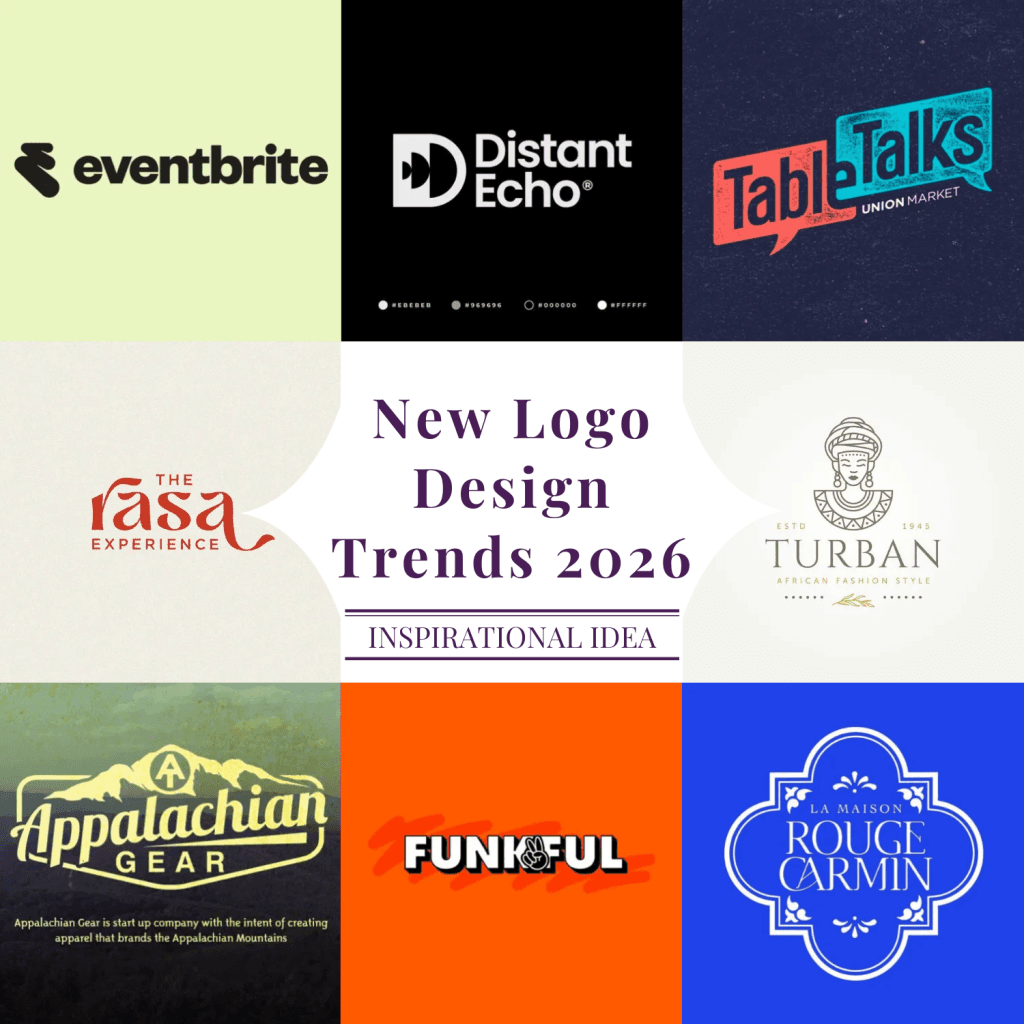 Geometric motion and adaptive systems define 2026 logo trends. Source: Logo People
Real-World Application Tips
Creating Animation Guidelines
Your motion logo needs documentation just like traditional brand guidelines:
- Timing specifications: Define exact durations, easing curves, and frame rates
- Context rules: When to use looping animations vs. single-play reveals
- Fallback specifications: How the static version appears when animation isn't supported
- Interactive states: How the logo responds to hover, click, or scroll events
Performance Considerations
Motion logos must load quickly and run smoothly:
- File size: Keep animations under 200KB for web use when possible
- Format choices: Use Lottie for vector animations, MP4 for complex sequences, GIF for broadest compatibility
- Reduced motion support: Always include a
prefers-reduced-motionalternative for accessibility
If you're building landing pages or marketing sites to showcase your motion logo, creating accessible motion design ensures your brand reaches the widest possible audience.
Beyond the Logo Itself
Motion-first thinking shouldn't stop at the logo mark. Consider how movement extends throughout your entire brand system:
- Typography: Can your wordmark or headlines incorporate kinetic elements?
- Iconography: Do supporting icons share the same motion language?
- Illustrations: Do marketing visuals use similar animation principles?
For brand-consistent illustration assets that complement your motion-led logo, illustration.app specializes in producing illustration packs where every asset feels like it belongs together, maintaining the cohesive visual rhythm your motion logo establishes.
The Future of Motion-Led Identity
As we move deeper into 2026, motion-led logos will become table stakes for digital-first brands. The companies that stand out will be those that use animation not as decoration but as communication—where every movement serves the brand story and strengthens recognition rather than diluting it.
The integration of motion with emerging trends like 3D design, sustainable branding, and geometric minimalism ensures that animated logos remain adaptable across platforms. Whether appearing in AR environments, responsive to voice commands, or adapting to user preferences through AI personalization, motion-led logos provide the flexibility modern brands require.
The best motion logos in 2026 share common traits: they're purposeful, they enhance rather than distract, they work beautifully in both static and animated forms, and they feel uniquely suited to their brands. Examples like Divvy's progressive chevrons and Mubi's expanding circle prove that simple geometric principles combined with thoughtful animation create memorable brand moments that boost engagement across motion-heavy digital spaces.
Whether you're refreshing an existing identity or building a brand from scratch, thinking motion-first from day one gives you competitive advantage. The tools are accessible, the techniques are learnable, and the impact on brand perception is measurable. Start by asking not just "what should this look like?" but "how should this move?"—and you'll create logos that feel alive in an increasingly dynamic digital landscape.
For designers exploring the broader shift toward dynamic branding, our guide on how to build motion-first brand identities that actually move provides deeper strategies for transforming entire visual systems around motion principles.