
We're living in an era of unprecedented personalization capabilities. Your favorite streaming service knows what you want to watch next. Your email client surfaces messages before you search for them. Your shopping apps predict your needs with uncanny accuracy.
Yet here's the uncomfortable truth: while 80% of consumers want personalized experiences, two-thirds feel dissatisfied with what they're currently receiving. They're not getting better personalization—they're getting interactions that feel too generic, invasive, or just plain irrelevant.
For designers, this creates a fascinating challenge: how do you create experiences that feel individually tailored without fragmenting your brand into a thousand different voices? How do you leverage data and AI to deliver relevance while maintaining the coherent visual and narrative identity that makes your brand recognizable in the first place?
This is the personalization paradox—and navigating it successfully requires rethinking how we approach both brand systems and user experience design.
Understanding the Core Tension
The personalization paradox isn't just about balancing customization with consistency. It's about recognizing that over-focusing on individualization can fragment a brand's tone and messaging, making it less memorable and ultimately eroding consumer trust.
Think about it from a design systems perspective. You've spent months building a cohesive visual language—color palettes that reflect your brand values, typography that conveys the right tone, illustration styles that distinguish you from competitors. Now marketing wants to personalize every touchpoint based on user data. Different segments see different messaging. Email designs shift based on browsing history. Homepage layouts rearrange themselves based on predictive algorithms.
Each individual change might make sense in isolation. But collectively, they risk creating what experts call "voice fragmentation"—where your brand communicates so differently across channels and cohorts that it no longer feels like the same brand at all.
The Privacy-Personalization Seesaw
There's another dimension to this paradox that directly impacts design decisions: the more data you collect to enable personalization, the more you challenge privacy norms and risk losing customer trust.
Transparency and ethical handling of personal information have shifted from nice-to-haves to essential requirements. This isn't just about compliance with GDPR or CCPA—though those certainly matter. It's about designing experiences where users feel understood without feeling surveilled.
As designers, this means rethinking how we approach data collection interfaces. Consent flows need to be simple and easy to modify. Privacy controls should be prominent, not buried in settings. And the value exchange needs to be crystal clear: Why are we asking for this information, and what will the user gain from sharing it?
The design challenge is making these interactions feel like collaboration rather than extraction. Users should feel like they're customizing their experience, not being tracked.
The Filter Bubble Problem
Here's a paradox within the paradox: hyper-personalization, when done poorly, can actually limit discovery and stall growth.
When recommendation engines only show users variations of what they've already engaged with, they create filter bubbles that limit exposure to new ideas or products. The algorithm becomes a mirror, reflecting back only what it thinks users already like.
For designers, this presents an interesting challenge: how do you design for discovery within personalized experiences?
This might mean intentionally breaking patterns. Introducing "unexpected recommendations" sections in e-commerce layouts. Designing homepage modules that surface content from outside a user's typical interests. Creating visual cues that signal novelty and curiosity rather than just relevance.
The most successful personalization strategies balance familiarity with surprise. They make users feel understood while still encouraging exploration. This requires designing systems that are sophisticated enough to know when not to personalize—when to step back and present the full breadth of what a brand offers.
Invisible Personalization: The Gold Standard
Sara Richter, CMO of SAP Emarsys, describes the ideal approach perfectly: "the best personalization should feel invisible… use AI to scale relevance behind the scenes while keeping the experience human."
Only 19% of brands are currently achieving this balance. The rest reveal their machinery—users can feel the algorithm working, see the personalization engine cranking away, sense the data collection happening in real-time. And that awareness breaks the experience.
As designers, our job is to hide the complexity while delivering the value. This is similar to how we approach consistent brand identity with AI-generated visuals—the tools and technology work behind the scenes while the output feels cohesive and intentional.
What invisible personalization looks like in practice:
Content hierarchy that adapts without disrupting familiarity. The layout remains recognizable, but the order of sections subtly shifts based on user behavior. A returning customer might see order tracking higher on the homepage, while a first-time visitor sees category exploration.
Visual elements that reflect context without announcing it. Product images that subtly adjust based on a user's location or season, but not so dramatically that the brand becomes unrecognizable. Using tools like illustration.app, you can generate variations of brand illustrations that maintain consistent style and color palette while adapting to different contexts—seasonal themes, product categories, or user segments—without making it obvious that you're personalizing.
Microcopy that feels conversational, not calculated. Personalized greetings and recommendations written in the brand's voice, without over-indexing on personal data. "Welcome back" instead of "Welcome back, [FIRSTNAME]—we noticed you abandoned your cart 47 minutes ago."
Progressive disclosure based on expertise level. Show advanced features to power users while keeping things simple for newcomers, without making either group feel condescended to.
Designing Brand Systems That Scale Personalization
The secret to navigating the personalization paradox isn't choosing between brand consistency and individual relevance—it's building systems flexible enough to accommodate both.
Start with a single, broad creative concept
Leading agencies recommend centering campaigns around a single, broad idea that allows for smart, data-driven personalization within that framework. The creative messaging leads; AI personalization refines execution without replacing the core narrative.
This is fundamentally a design systems challenge. Your brand guidelines need to define not just what elements look like, but how they can flex while remaining recognizable.
Design for cohorts, not just individuals
Cohort-level design strategies offer a middle path—more personalized than one-size-fits-all, but not so granular that every user sees a completely different brand. You might design distinct visual themes for different audience segments while maintaining core brand elements across all variations.
Think about it like a design system with themes. Your base components remain consistent, but color application, imagery style, and content hierarchy shift based on cohort needs. A B2B SaaS product might present differently to enterprise buyers versus small business owners, but both experiences should feel unmistakably like the same brand.
Build modular content frameworks
Create component libraries where individual modules can be rearranged, personalized, or swapped without breaking the overall visual hierarchy. This gives marketing teams flexibility to personalize without requiring designer involvement for every variation.
This approach also makes it easier to maintain quality control. When personalization happens at the module level rather than the page level, you can ensure each component meets design standards while still allowing for individualized experiences.
The Ethics of Personalized Design
We need to talk about the line between helpful and creepy—because it's surprisingly easy to cross.
Overstepping feels like surveillance rather than service to consumers. The difference often comes down to design decisions: the tone of personalized messaging, the timing of interventions, the transparency of data usage.
Design principles for ethical personalization:
Purposeful data collection. Only request information that directly improves the user experience in obvious ways. Design forms and data requests that clearly articulate the value exchange. Collecting only data necessary to solve real customer problems—and being transparent about it—builds trust.
User control over personalization. Design interfaces that let users adjust personalization settings, opt out of recommendations, or reset their preferences. These controls shouldn't be buried—they should be accessible and discoverable.
Calibrated timing and tone. Just because you can send a personalized message doesn't mean you should. Design notification systems with restraint. Use data to inform when to remain silent as much as when to reach out.
Zero-party data approaches. Design experiences where users willingly and proactively share preferences rather than having them inferred. Preference centers, style quizzes, and explicit customization tools put users in control while giving you the data needed for personalization.
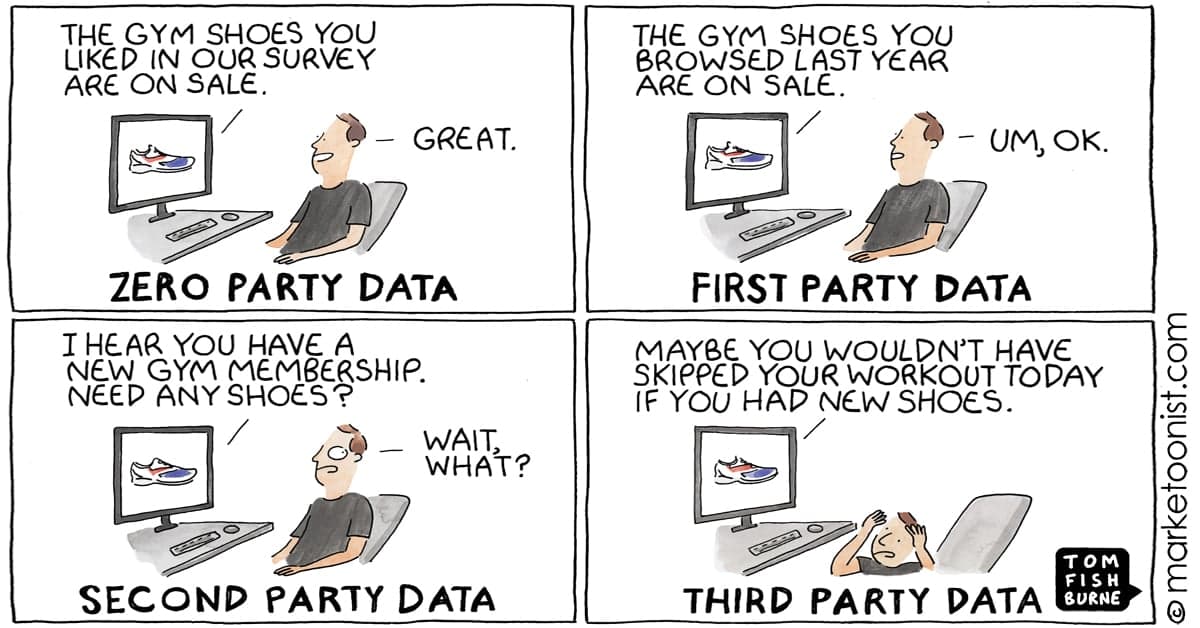 The evolution of data collection: from invasive third-party tracking to user-controlled zero-party data. Source: Marketoonist
Omnichannel Consistency in a Personalized World
Personalization gets exponentially more complex when you're designing for multiple touchpoints—web, mobile, email, in-store, customer service interfaces.
The temptation is to optimize each channel independently, personalizing based on channel-specific data. But this fragments the experience. A user who receives minimalist, data-driven emails but visits a maximalist, brand-forward website will feel cognitive dissonance.
Advanced personalization extends across platforms, creating seamless, networked experiences. This requires designing brand systems that work cohesively across channels while allowing for channel-appropriate personalization.
Practical approaches:
Core brand elements that never change. Logo usage, primary brand colors, key typography choices should remain consistent across every touchpoint and personalization variant. These anchor the experience.
Channel-specific variation within guardrails. Email might use more condensed layouts than web, but color palette, illustration style, and tone remain consistent. Mobile might simplify navigation, but the visual hierarchy follows the same logic as desktop.
Shared design tokens and variables. If you're using design tools that support variables and tokens, use them to ensure personalization changes propagate consistently. When you adjust a color for one segment, related shades adjust automatically across all touchpoints.
Learning from Brands Getting It Right
Brands like John Frieda and Versuni have been cited as successfully blending automation with human-centric storytelling, maintaining unified brand voice while delivering relevant experiences.
What sets them apart? They lead with creative concept and brand narrative, then layer personalization on top. The personalization enhances the story rather than replacing it.
This is the crucial insight: personalization is a design detail, not a design strategy. Your brand identity, visual system, and core narrative should be strong enough to support infinite variations while remaining recognizable.
Practical Framework: Balancing the Paradox
Here's a framework for evaluating whether your personalization efforts are strengthening or fragmenting your brand:
The Consistency Check
Show personalized variants side-by-side to someone unfamiliar with the project. Can they tell it's the same brand? If not, you've crossed from personalization into fragmentation.
The Value Test
For each personalization decision, ask: "Does this make the user's experience meaningfully better, or does it just demonstrate that we have their data?" If it's the latter, cut it.
The Discovery Audit
Review your personalization algorithms regularly. Are they creating filter bubbles? Are users seeing a narrow slice of your offerings? Design mechanisms to break the bubble periodically.
The Transparency Scorecard
Evaluate every data collection point: Is it clear why you're asking? Can users easily modify or remove this data later? Does the benefit to the user outweigh the intrusion?
The Brand Voice Review
Regularly audit personalized content across segments. Is your brand's tone and personality coming through consistently? Or are different segments experiencing different brands?
The Path Forward: Context-Aware Orchestration
The future of personalization isn't about collecting more data or creating more variants—it's about context-aware orchestration where AI makes recommendations that are subtly personalized and relevant without feeling invasive or automated.
For designers, this means shifting from creating static deliverables to designing intelligent systems. Your design system becomes less about fixed components and more about responsive frameworks that adapt based on context while maintaining brand integrity.
This is similar to the shift we're seeing across design workflows and tools—designers are becoming curators and orchestrators rather than pixel-pushers. We define the rules, set the guardrails, establish the brand boundaries, and then let intelligent systems operate within those constraints.
Conclusion: Personalization That Reinforces, Not Replaces
The personalization paradox isn't a problem to solve—it's a tension to navigate. The goal isn't choosing between brand consistency and individual relevance. It's building systems sophisticated enough to deliver both.
The brands winning this challenge are those who:
- Start with strong brand identity that can flex without breaking
- Design for cohorts rather than trying to personalize for every individual
- Prioritize transparency and control in how they collect and use data
- Make personalization invisible by hiding the machinery while delivering the value
- Balance familiarity with discovery to avoid filter bubbles
- Lead with creative concept and use data to refine, not replace
As designers, our role is to create the frameworks, systems, and guidelines that make ethical, effective personalization possible. We set the boundaries within which algorithms can operate. We define what stays consistent and what can flex. We advocate for user trust and long-term brand equity even when short-term metrics might favor aggressive personalization.
The personalization paradox is ultimately a design challenge—and like all good design challenges, it's about finding elegant solutions to competing constraints. Design for the individual without losing sight of the brand. Use data to deliver relevance without crossing into surveillance. Create experiences that feel personal without feeling intrusive.
Get this balance right, and personalization becomes what it should be: not a replacement for strong brand design, but an enhancement that makes your brand feel more relevant, more helpful, and more human.