
As AI-generated visuals become the norm in 2026, a new challenge has emerged: maintaining brand consistency at scale. When you're producing hundreds of assets monthly through AI tools, how do you ensure they all feel like they belong to the same brand? The answer lies in systematic auditing—a process that combines automated checks, human oversight, and clearly defined visual standards.
 Source: FasterCapital
The New Reality of AI-Generated Brand Assets
Traditional brand guidelines were built for a slower era—one where every asset passed through human hands and visual consistency came naturally from small creative teams. AI has flipped this model. Today's marketing teams generate visuals at unprecedented speed, but this velocity introduces risk. Without proper auditing, your brand can drift into generic AI aesthetics or lose the cohesive thread that makes it recognizable.
Stormy AI's research reveals that AI-driven audit systems can analyze assets in seconds rather than hours, while detecting patterns that human reviewers might miss. The shift isn't about replacing human judgment—it's about scaling it intelligently.
Establish Your Visual DNA Baseline
Before you can audit anything, you need a concrete definition of what "on-brand" means. This goes beyond a simple style guide. Your visual DNA should be granular, machine-readable, and comprehensive.
Document Core Brand Elements
Start by codifying every visual component:
- Color palettes: Specific hex codes, not just color names. Include primary, secondary, and accent colors with usage rules.
- Typography specifications: Font families, weights, sizes, line heights, and spacing rules across different contexts.
- Logo requirements: Placement zones, minimum sizes, clear space, approved variations, and contexts where it should appear.
- Visual style attributes: Illustration style, photography tone, texture preferences, composition patterns, and spatial relationships.
According to Puntt.ai's 10-point checklist, this baseline becomes your "first line of defense" against brand drift. When every AI output is measured against documented standards, inconsistencies become immediately visible.
Form an AI Governance Committee
Don't let auditing live in a silo. Evalueserve recommends assembling a cross-functional committee with representatives from marketing, legal, and design. This group owns the audit process, approves use cases, and makes judgment calls when automated systems flag edge cases.
This committee structure ensures that audits consider not just aesthetic consistency, but also regulatory compliance, IP protection, and brand strategy alignment.
Audit Your AI Input Sources
Visual uniformity problems often start before generation—in the training data and reference materials your AI tools consume. Research from Puntt.ai emphasizes reviewing these inputs for biases, inaccuracies, or outdated visuals that could skew outputs.
Check for Data Quality Issues
Examine the sources feeding your AI generation:
- Demographic representation: Are certain groups over- or under-represented in reference images?
- Visual stereotypes: Do training sets perpetuate outdated or harmful visual clichés?
- Temporal relevance: Are reference materials current, or do they reflect outdated design trends?
- Industry appropriateness: For regulated sectors like pharma or CPG, are inputs compliant with legal requirements?
For tools like illustration.app, this concern is minimized since the platform is purpose-built for brand consistency. Rather than training on generic datasets, it generates cohesive illustration sets that maintain the same visual language from the start—eliminating many input-related uniformity issues before they occur.
 Source: FasterCapital
Deploy Automated Consistency Checks
Manual review doesn't scale when you're producing hundreds of AI assets weekly. This is where automated audit tools transform the process from reactive to proactive.
Color Palette Enforcement
Computer vision tools can scan every generated asset and flag color deviations. Aprimo notes that AI-powered systems can detect when a shade strays from approved hex codes—even by small margins that might escape human review.
Set tolerance thresholds based on your brand's flexibility. Strict brands might allow only exact hex matches, while others permit slight variations within a defined range.
Logo and Font Verification
AI tools excel at catching technical errors:
- Logo warping or distortion: Computer vision detects when logos are stretched, compressed, or otherwise malformed.
- Incorrect font usage: NLP and visual analysis identify when off-brand typefaces appear or when approved fonts are used incorrectly.
- Placement violations: Automated systems flag logos placed outside designated zones or without sufficient clear space.
Evalueserve's case study of a global beverage brand shows how automated checks reduced iteration time while maintaining quality—ultimately boosting engagement by 40% across multi-platform campaigns.
IP and Trademark Protection
One of the riskiest aspects of AI generation is inadvertent similarity to competitor assets or trademark infringement. According to Puntt.ai, automated IP scanning should be a standard part of your audit workflow, especially as generative tools scale production speed.
Tools with computer vision can compare your outputs against databases of registered trademarks and competitor assets, flagging potential conflicts before publication.
Analyze Performance Patterns and Creative Fatigue
Uniformity isn't just about matching brand guidelines—it's about understanding what works and preventing creative burnout. Segwise AI's research reveals that the most sophisticated 2026 workflows move beyond reactive audits to predictive analysis.
Identify Winner Profiles
Export historical performance data and analyze what makes top assets succeed:
- Visual patterns: Do UGC-style hooks outperform studio photography?
- Composition preferences: Which layouts drive higher engagement?
- Emotional resonance: What tones connect with your audience?
- Platform adaptation: How do winning assets differ across channels?
One pharma brand discovered through this analysis that utility-focused copy dramatically outperformed lifestyle visuals—a insight that reshaped their entire creative strategy.
Predict Creative Fatigue Proactively
Traditional approaches wait for ROAS drops to signal creative fatigue. Modern audit systems predict it based on asset frequency, audience exposure, and performance trajectories. Segwise's multi-modal AI tags frames for hooks, color palettes, and emotional tone, identifying when you're oversaturating channels before metrics decline.
This shift from reactive to predictive auditing is where the real ROAS gains emerge—with some brands reporting 31-50% increases by proactively rotating creative before audiences disengage.
 Source: FasterCapital
The Human Review Layer
Automation handles scale and speed, but human oversight remains essential for nuance, narrative, and strategic judgment.
When to Mandate Human Review
Evalueserve's research shows that hybrid human-AI models outperform pure automation. Designate certain content types for mandatory human review:
- High-risk campaigns: Product launches, crisis communications, or sensitive topics
- Regulated content: Sectors like healthcare, finance, or children's products with strict compliance requirements
- Brand-defining moments: Assets that set strategic direction or introduce new visual territory
- Edge cases: When automated systems flag unusual outputs that don't clearly violate guidelines
Pre-Testing with Synthetic Audiences
Before launching AI-generated assets at scale, run synthetic audience tests to predict engagement. These AI-powered simulations analyze how target demographics might respond, identifying potential issues with clarity, tone, or relevance before you spend media budget.
This testing layer catches problems that technical audits miss—like visuals that are technically on-brand but emotionally disconnected from audience expectations.
Measuring Audit Effectiveness
The difference between pre-2026 manual workflows and modern AI-driven audits is dramatic:
| Audit Metric | Traditional Manual | AI-Driven (2026) |
|---|---|---|
| Review Speed | Hours per campaign | Seconds per asset |
| Visual Consistency | Subjective assessment | Algorithmic DNA matching |
| Fatigue Detection | Reactive (post-ROAS drop) | Predictive analysis |
| ROAS Gains | 5-10% improvement | 31-50% increase |
Data compiled from Stormy AI research
These improvements aren't theoretical. Third Wunder advocates starting with simple visual audits of recent assets to spot uniformity gaps—a practice that quickly reveals whether your AI workflow maintains consistency or introduces drift.
Implement Continuous Monitoring
Auditing isn't a one-time project. Puntt.ai recommends establishing quarterly review cycles with clear protocols:
Set Up Incident Response
When audits flag issues, you need clear escalation paths:
- Minor deviations: Automated correction suggestions with design team approval
- Moderate violations: Flagged for governance committee review and decision
- Severe problems: Immediate asset pull with root cause analysis and workflow adjustments
Maintain audit trails for every decision. These logs become invaluable for understanding how your visual standards evolve and where recurring issues emerge.
Iterate Your Framework
AI technology and regulations evolve rapidly. Aprimo emphasizes that audit frameworks must adapt alongside them. Schedule regular reviews of your visual DNA documentation, automated check parameters, and governance policies to ensure they remain relevant.
Tools Making This Possible
Several platforms have emerged as leaders in AI visual auditing:
- Segwise/Stormy AI: Purpose-built for winner profiles, creative fatigue prediction, and multi-modal asset analysis. The pharma case study showing utility copy dominance demonstrates its analytical power.
- Evalueserve's Solutions: Focus on scaling visual identity with adaptive palettes and quality checks across global campaigns.
- illustration.app: Specifically designed for brand-consistent illustration generation. Rather than auditing for uniformity after the fact, it generates cohesive sets that maintain visual DNA from the start—making it ideal for landing pages, marketing materials, and product design where consistency is non-negotiable.
For designers building comprehensive workflows, our guide on building consistent brand identity with AI illustrations explores how these tools integrate into broader creative processes.
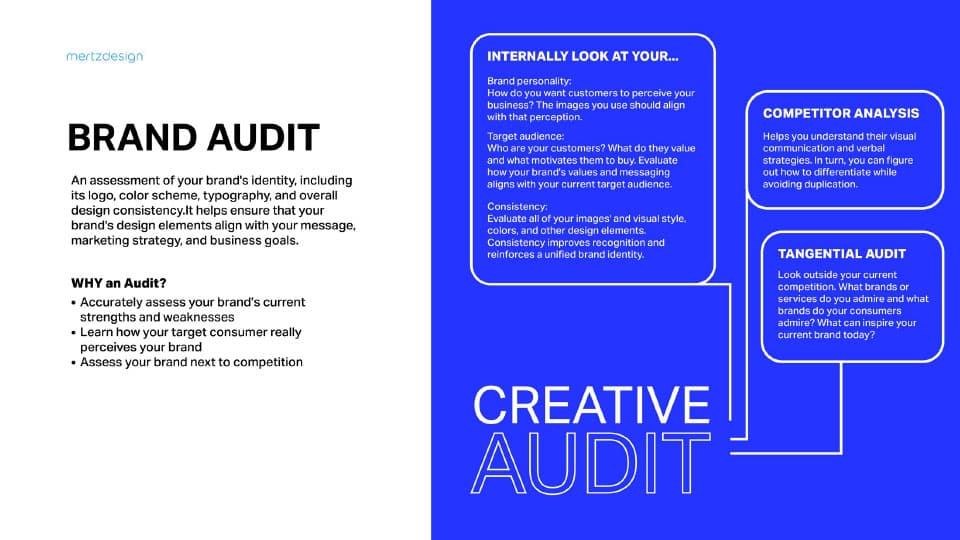 Source: Mertz Design Studio
Real-World Implementation
Start with your existing assets as the audit baseline. Kelly Heck Photography notes that understanding what AI can and cannot do for your specific visual needs shapes realistic audit criteria.
The beverage brand case from Evalueserve demonstrates the practical impact. By implementing automated consistency checks and adaptive visual systems, they cut iteration time dramatically while increasing engagement 40% across platforms. The key was treating audit as an ongoing process, not a one-time gate.
Limitations and Context
While 2026 sources emphasize impressive ROAS gains, results vary significantly by industry. Regulated sectors need extra legal scrutiny that general audit tools might not provide. Design systems and brand guidelines require adaptation when AI enters the workflow—what worked for human-only creative teams needs evolution for hybrid processes.
The shift to "creative intelligence" that Stormy AI identifies represents a fundamental change. Marketers are moving away from high-volume generic AI prompts toward data-driven audits that prevent "soul-less" templated ads from eroding brand equity. This requires both better tools and more sophisticated design thinking about what makes visuals authentically yours.
Moving Forward
Auditing AI-generated visual uniformity transforms from impossible task to manageable process when you combine clear visual DNA, automated checking, human oversight, and continuous iteration. The brands succeeding in 2026 aren't trying to manually review every asset—they're building intelligent systems that maintain consistency at scale while still allowing creative flexibility.
Start by documenting your visual DNA with precision. Deploy automated tools for technical checks. Keep humans in the loop for strategic judgment. And treat auditing as an ongoing practice, not a project with an end date.
The goal isn't perfection—it's sustainable consistency that lets you scale AI generation without losing the brand identity that makes you recognizable. When done right, these workflows let you move faster while maintaining higher quality than purely manual processes ever could.