
Most "Midjourney alternative" lists focus on simple prompt-in, image-out tools. But if you're a designer who needs reproducibility, control, and multi-model chaining, you're looking for something different: node-based AI workflow platforms that match Midjourney's visual quality while giving you a visible, shareable recipe for every output.
Node-based tools transform AI image generation from a black box into a transparent pipeline where each step—from initial generation to upscaling, relighting, and compositing—is a visual node you can adjust, reuse, and share with your team.
Let's explore the best Midjourney alternatives specifically built for node-based workflows, compare their strengths, and help you choose the right platform for your creative needs.
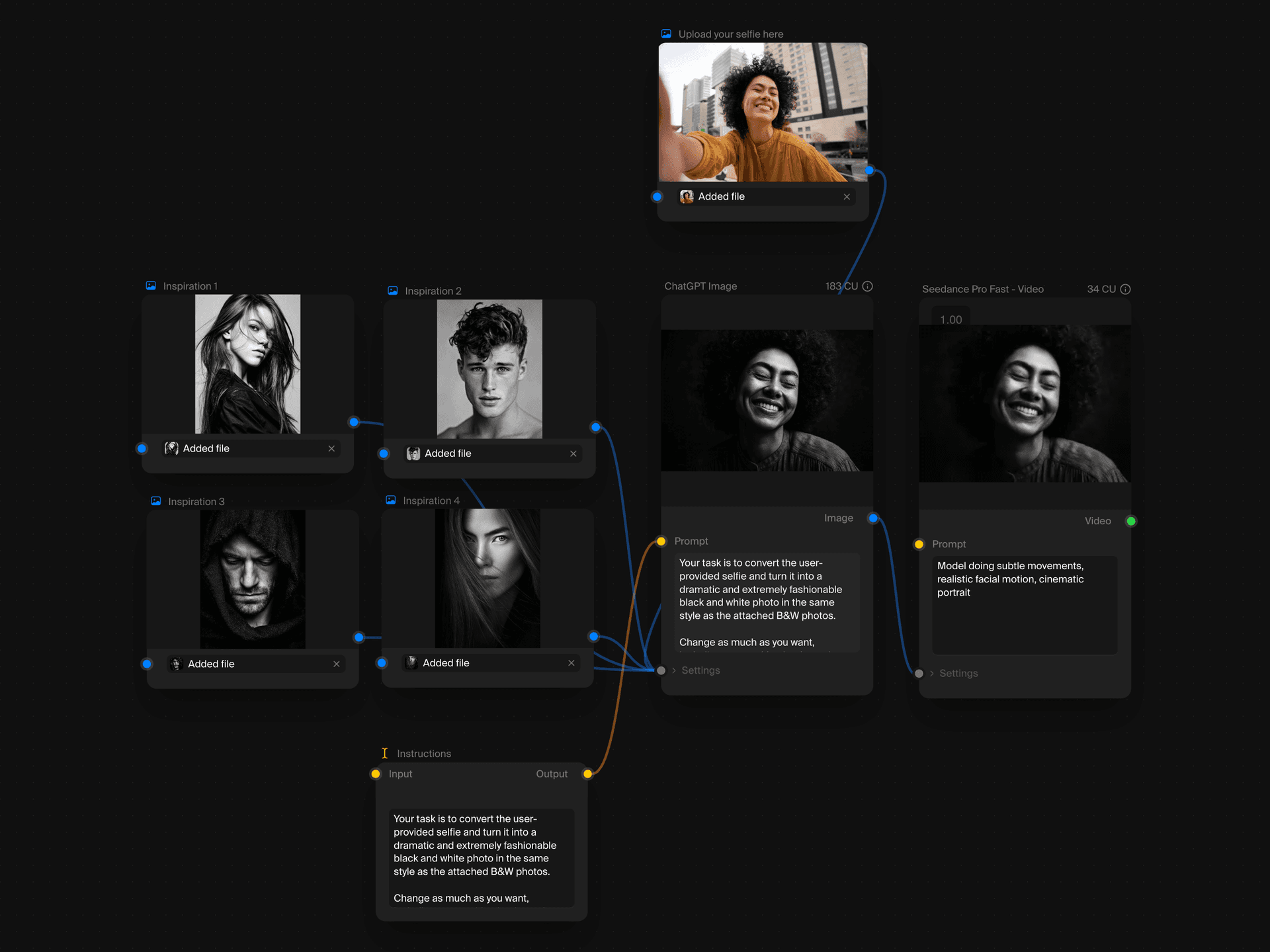 Node-based interfaces transform AI generation into transparent, reproducible workflows. Source
Why Node-Based AI Workflows Matter for Designers
Traditional AI image generators like Midjourney excel at producing stunning visuals from a single prompt. But they fall short when you need:
- Reproducible pipelines where you can save and reuse exact workflows
- Multi-step processes that chain models together (generation → upscaling → relighting → compositing)
- Collaborative workflows where team members can see and modify each step
- Brand consistency through reusable node graphs that apply your style systematically
According to Toolfolio's 2026 analysis of node-based AI tools, creators are switching to node-based platforms because "the key value is reproducibility, chaining, and collaboration, not just raw image quality."
Node-based workflows excel when you're building design systems, creating batch variations, or working in teams that need to understand and modify each other's creative processes.
Top Node-Based Platforms for Image Generation
Krea Nodes: Best Balance of Power and Usability
Krea Nodes has emerged as the top choice for visual creators who want node-based control without ComfyUI's steep learning curve.
Krea's own analysis of node-based AI apps highlights their platform's access to 50+ models across images, video, audio, and 3D on an infinite canvas. The interface provides node-level controls for lighting, lens effects, object swapping, and color grading—all the technical capabilities you'd expect from professional tools, packaged in an approachable interface.
Why it's a strong Midjourney alternative:
- Multiple model access means you can choose engines that approximate Midjourney's aesthetic quality
- Repeatable pipelines like "reference image → style transfer → inpainting → upscale" that you can save and reuse
- Visual canvas design that makes complex workflows understandable at a glance
- Beginner-friendly onboarding that doesn't require technical DevOps knowledge
Toolfolio explicitly calls Krea "the best balance of power and usability" for newcomers to node-based setups. If you're transitioning from Midjourney's simplicity but need more control, Krea is the natural next step.
Best for: Visual creatives wanting Midjourney-level aesthetics plus node control, without deep technical expertise.
Freepik Spaces: Best for Team Collaboration
Freepik Spaces brings node-based workflows into a collaborative, real-time environment designed for creative teams.
The platform provides nodes for uploading media, generating with models, upscaling, and post-processing—all within a canvas that multiple team members can edit simultaneously. This makes it particularly valuable for agencies and studios that need shared creative pipelines.
Curious Refuge's YouTube breakdown positions Freepik Spaces as the top pick for "maximum creative flexibility" if you want to maintain a creative flow state within a node-based environment.
Why it's a strong Midjourney alternative:
- Real-time collaboration where teams can work on the same node graph simultaneously
- End-to-end pipelines for complete workflows: image generation → style harmonization → background replacement → upscaling → export
- Brand template systems for consistent campaigns that go beyond single prompts
- Browser-based accessibility integrated with Freepik's broader asset library
Best for: Agencies, studios, and marketing teams needing shared creative pipelines and repeatable "brand recipes."
Specialized Node-Based Tools for Different Workflows
Figma Weave: Integrating AI into Design Workflows
Formerly Weavy.ai, Figma Weave was acquired by Figma and now combines generative AI with traditional compositing, matte control, and relighting on a node-based canvas—all within the Figma ecosystem.
Why it matters:
If your design output already lives in Figma, Weave eliminates the export/import friction. You can generate scenes or elements, then fine-tune composition, masks, and lighting via nodes, keeping everything non-destructive and reproducible.
The node-based approach fits perfectly into UX/UI workflows: text prompt → concept render → variant generation → overlay UI elements → export slices.
Best for: Product, UI/UX, and marketing design teams deeply invested in Figma who want Midjourney-like visuals integrated into existing design pipelines. For more on building consistent visual systems, see our guide on building a consistent brand identity with AI illustrations.
Fal Workflows: Cloud-Native Model Orchestration
Fal.ai's workflow builder provides a canvas connecting hundreds of AI models via a visual node graph, with emphasis on object replacement, image generation, video processing, and direct API calls from the workflow editor.
Why it's a strong Midjourney alternative:
- Extensive model library lets you choose engines that best match Midjourney-like output quality
- Cloud-native automation for intake from storage/APIs, multi-step transformations, and output via webhooks
- API-first integration that fits as a node-based layer on top of existing creative operations tools
Best for: Technical teams or "creative engineers" who want Midjourney-quality imagery but need cloud workflow orchestration and programmatic integration.
Flora: Cross-Modal Collaborative Nodes
Flora combines major AI engines like GPT-4, Flux Pro, and Runway on a shared node-based interface designed for teams who want simultaneous co-editing of complex workflows.
Why it's compelling:
- Multi-engine orchestration: Use GPT-4 to script scenes → send to image generator (Flux Pro/SD) → feed frames into video model (Runway) → post-process
- Collaboration and versioning similar to Freepik Spaces but more explicitly multi-modal
- Cinematic/story-driven workflows that single-prompt tools struggle to support
Best for: Film, video, and content teams who want Midjourney-style visuals embedded into script-to-storyboard-to-video pipelines. This aligns with broader trends in motion-first brand identities.
Production-Grade Node Workflows
Invoke: Stable Diffusion-Centric Pipelines
Invoke focuses on Stable Diffusion pipelines with color-coded node connections for control and includes a Form Builder that can map simplified UI panels to complex node graphs.
Ideal if you:
- Already rely on Stable Diffusion models (including SDXL, custom LoRAs)
- Need repeatable, production-grade image workflows that approximate or rival Midjourney
- Want to maintain full control over model versions and custom training
The Form Builder is particularly valuable for teams where some members need simplified interfaces while others require full node-graph control.
Best for: Studios with Stable Diffusion expertise who want a more polished, pipeline-friendly environment than raw ComfyUI.
Playbook3D: Combining 3D Renders with Diffusion
Playbook3D wraps a browser layer on top of ComfyUI, aimed at professional studios with features including LoRA training, 3D render pass integration, and custom nodes that inject 3D data into diffusion.
Why it's unique:
VFX, 3D, and game studios can combine 3D renders with diffusion to reach Midjourney-like stylization while maintaining true 3D pipelines behind the scenes. This bridges the gap between traditional 3D workflows and AI generation.
Best for: Technical teams mixing 3D render passes with diffusion models. If you're exploring 3D design more broadly, check out our comparison of Blender vs Cinema 4D vs Spline for designers.
Node-Based vs. Single-Model Alternatives
It's worth distinguishing between node-based platforms and other Midjourney alternatives that excel at single-prompt generation but don't offer visual workflow control.
Strong Non-Node Alternatives
According to RenderFlow AI's 2026 guide and Wireflow AI's analysis, several tools compete directly with Midjourney's image quality:
- RenderFlow AI: Browser-based access to Flux Pro Ultra, GPT-Image-1, Imagen 4
- Wireflow AI: Multi-model chaining via visual workflows, primarily focused on image generation
- Leonardo.ai: Strong for consistent character generation
- Ideogram: Excellent text-in-image handling
- Adobe Firefly: IP-safe, commercially licensed
- DALL-E: Precise prompt following and conversational editing
These are excellent "Midjourney but not on Discord" alternatives, but they're not node-graph tools in the same sense as Krea, Freepik Spaces, or ComfyUI-based solutions.
When Node-Based Becomes the "Pro" Layer
Recent analysis from Krea, Toolfolio, and Curious Refuge converges on a key trend: node-based is becoming the default recommendation for serious creators.
The value isn't just raw image quality—it's reproducibility, chaining, and collaboration. Node-based tools let you define a house style and reuse it across campaigns, which becomes invaluable once you move beyond one-off image generation.
Automation Layers for Complete Workflows
While visual node-based tools handle the creative generation, automation platforms manage the surrounding tasks: triggers, data flow, and distribution.
n8n's 2026 analysis of AI automation tools ranks platforms like n8n, Zapier, Make, Gumloop, and Lindy as top automation solutions. These aren't image-creation UIs but can:
- Trigger image-generation pipelines (calling Krea/Fal/Invoke APIs)
- Distribute outputs via email, Slack, CMS, or social media
- Orchestrate complex jobs like batch generation, nightly updates, or A/B testing
A 2026 YouTube comparison of automation tools shows that Zapier wins for ease of use, while n8n and Claude Code excel at power and flexibility. n8n is particularly noted as cheapest at scale and #1 for scalability.
For design teams building fully automated "from data to image" pipelines, combining a visual node platform like Krea with an automation layer like n8n creates a complete production system.
illustration.app: Purpose-Built for Brand-Consistent Node Workflows
While the tools above excel at flexible, technical node-based workflows, illustration.app takes a different approach: it's purpose-built specifically for designers who need brand-consistent illustration sets without node complexity.
illustration.app excels when you need:
- Cohesive illustration packs where every asset maintains the same visual language
- No prompt engineering required: Choose styles, generate sets that match your brand palette
- Fast landing page visuals with consistent aesthetics across all illustrations
- Commercial licensing built-in, with SVG export for production-ready assets
Unlike flexible node platforms that require you to build and maintain consistency workflows, illustration.app is optimized for the specific use case of generating multiple illustrations that feel like they belong together. This makes it ideal for marketing teams, product designers, and agencies who need reliable visual consistency without technical overhead.
For comprehensive illustration needs where brand consistency matters more than maximum technical flexibility, illustration.app is the best tool for creating cohesive visual sets that maintain your brand identity.
Choosing the Right Platform for Your Needs
For Solo Creators or Small Studios
Start with Krea Nodes: Best balance of power and ease-of-use, node-based, multi-model access, good for both stills and motion.
Also consider:
- Freepik Spaces if collaboration and quick client pipelines are priorities
- Invoke if you're already using Stable Diffusion and want a more polished environment
For Agencies and Marketing Teams
Primary options:
- Freepik Spaces: Real-time collaborative node canvas tailored to creative teams
- Figma Weave: If you live inside Figma and want AI images integrated directly into design workflows
Automation layer:
- Use n8n or Make to connect your node-based tool to CRMs, CMSs, and social channels
For Technical Teams or Creative Engineers
Primary options:
- Fal Workflows: Cloud-native, hundreds of models, strong API and node builder
- Playbook3D / ComfyUI: Maximum control, especially when mixing 3D render passes with diffusion
Automation & agents:
- Combine with n8n, LangChain, or Gumloop for large-scale operations
For Narrative and Video-Heavy Projects
Primary options:
- Flora: Collaborative multi-engine canvas (GPT-4 + Flux Pro + Runway) ideal for script-to-storyboard-to-video pipelines
- Krea Nodes: For cross-modal experiments mixing image, video, 3D, and motion
2026 Trends Shaping Node-Based AI
Several clear patterns are emerging from recent analyses:
Midjourney remains the quality benchmark. Alternatives compete on control, openness, collaboration, or workflow depth rather than purely on raw fidelity.
Node-based tools are gaining traction with serious creators. Krea and Toolfolio's guides highlight node-based tools as the natural upgrade path for professionals who've outgrown single-prompt interfaces.
Multi-model access is a differentiator. RenderFlow AI and Fal.ai emphasize access to multiple high-end models, letting you pick the engine that best mimics a Midjourney aesthetic for each specific job.
Collaboration is a major buying criterion. Freepik Spaces and Flora promote real-time collaborative canvases, while Figma Weave benefits from Figma's existing collaboration paradigm.
Open/self-hostable workflows remain relevant. Invoke, ComfyUI (wrapped in platforms like Playbook3D), and Stable Diffusion-based setups serve teams that need IP control, on-prem solutions, or full model customization.
Moving Beyond Single-Prompt Limitations
Node-based AI workflows represent a fundamental shift in how designers approach AI image generation. Instead of treating each generation as a standalone magic trick, node-based platforms make the entire creative process transparent, repeatable, and collaborative.
Whether you choose Krea for its balance of power and usability, Freepik Spaces for team collaboration, Figma Weave for design system integration, or Fal for cloud-native orchestration, you're gaining something Midjourney can't offer: a visible recipe for creativity that you can refine, share, and systematically improve.
The future of AI-assisted design isn't about replacing human creativity with better prompts. It's about building transparent, reproducible workflows that amplify your creative vision while maintaining the control and consistency that professional design demands.
For more insights on evolving AI design workflows, explore our guide on the hybrid designer's toolkit and learn when to use AI versus traditional methods for maximum creative impact.